There was an IFE TSAG (Technical Strategy and Advisory Group) meeting yesterday. Among the subjects discussed was the very real prospect of a separate IFE examination for fire investigation. Please let me have your views. It was also another opportunity to express the need for more investment in the IFE website.
The new (and most welcome) IFE journal also came up. All special interest groups will be expected to play a significant part in the journal. Like any journal, it will stand or fall on it's content so please start writing. Let's get some quality content and some lively debate going.
Saturday, 28 April 2012


Wednesday, 25 April 2012
Our SIG
There will be an IFE TSAG (Technical Services and Advisory Group) meeting this Friday at which the special interest groups will be discussed. Please forward any views and opinions to me if you have time.
I will continue to lobby for investment in a good quality forum site for our group. I believe it is the best, most immediate and cost effective way of developing membership involvement.
In the longer term I will also lobby for a dedicated IFE FI qualification by examination.
I am sure the new IFE journal will require much involvement from SIGs so please start work on articles in advance.
With effect from May 1st I will be full time employed by IFIC Forensics. Part of my remit will be to recruit further investigators.
I personally see this as a conflict of interest and for that reason I would prefer to step down as chair. One or more of you may be better able or placed to take up the reins of this SIG. We are not burdoned by a formal constitution so please let me know if you would be interested. There is great potential.
Saturday, 17 March 2012
Dynamic Risk Assessment (DRA)
Please check out this link to a lively and informative discussion: Who's using dynamic risk assessment (DRA)? This is a topic of interest to us all. Please participate.
Let's be honest. Do we all actually write a true and acurate Risk Assessment of our fire scenes? Do we all update them as we proceed? Or are we paying lip-service to a procedure that serves to protect us?
DRA absolutely applies to us: we will remove gloves, mask, helmet etc. for various reasons in the course of a site examination but how do we ensure we are taking right and proper action and how do we record it? How will we defend our actions if something goes wrong?
It is too easy to be complacent at a fire scene:
Some in the past have paid the price of not using masks and I suspect many of us are still not fully aware or appreciative of the dangers. Nitrile gloves are great for sample examination but are not suitable for the main scene work. And what use is a helmet without a strap?
Fire Service investigators are much better equiped. The private sector must follow suit. Yes it may look odd at some scenes to appear dressed up for a pot-holing expedition but we would look pretty stupid going pot-holing in a strap-less bump hat and Hi-Viz vest!
Monday, 23 January 2012
FI qualifications, standards and credibility
Once again the IAAI-UK have managed to put on a very useful event. From the theft of cables underground to fire tests in space!
At the end of the meeting Pete Mansi raised the very important topic of how we, as forensic investigation practitioners, fill the credibility gap left by the loss of the CRFP. I agree with Pete that it falls upon us and the various organisations we belong to or are associated with to move this issue forward (before somebody does it for us). FI is in danger of becoming even more fragmented and inconsistent across the UK.
I would like to open the discussion now in our small group. Let's discuss the issues and then think about any solutions. Here are some thoughts:
CRFP could be replaced by a similar subscription based body that is involved only with FI but what organisation could take this on?
FI Training is seemingly run by whoever wishes to do so. To what standards? What input? What evaluation? Is it really all down to cost?
Degree courses etc. are many-fold. What is the career path for the candidates? What is the value to the industry?
Private providers are becoming profligate. They will get work eventually but the private sector is a minefield and expert witnesses can be prosecuted. Are we heading for potential bun-fights in court?
Fire Services are continually cutting back and dedicated, full time FI is a luxury item. What are the consequences? Are skills lost or diluted?
The loss of FSS was a strange turn of events for many of us I am sure. The private sector is slowly responding but what are the required standards? As long as they find somebody to do the job at the right price do the Police care? What are their criteria for engaging forensic experts?
Communication and sharing of information is still very poor. The IFE will, hopefully, be able to provide a forum when there is sufficient IT funds available but that will never be sufficient to fill the gap.
I like what I hear about what appears effectively to be the Nationalisation of the Fire Service in Scotland. CFOA are working on FI standards for England and Wales (not sure about NI. Can someone enlighten me please?). But none of this will affect the private market.
And what about the private market? They are not bound by any rules, procedure or guidelines but they get the job done. And in many cases they get the job done very well indeed.
Over to you..........
Monday, 10 October 2011
FI skills and knowledge
With the abolition of CRFP there still exists a gap in the acreditation of FI pratitioner's skills.
There have also been many examples in Courts of poor procedure and knowledge of experts in the field.
As a profession we need to seek some means to ensure good skills and knowledge and to show maintenance of same.
The basic training-based foundation has never been good enough due to it's short duration. Practitioner's advanced skills and knowledge has depended upon the individual's seeking of further education and self-learning.
The problem is that without a good under-pinning knowledge any subsequent experience gained may often be wasted.
I would like to canvas opinion on the following:
1. Should the IFE consider running a specific FI examination other than the current members paper?
2. Should the IFE consider setting up a Register of FI practitioners (similar to the current register of Fire Risk Assessors)?
3. Is there anything else the IFE should consider?
IAAI CFI is OK but is not considered particularly desirable or required in the UK and does not test knowledge in great detail.
The Forensic Science Society FI diploma is a detailed but expensive option.
There are a number of Universities offering courses but there are considerable costs.
I am still waiting for the IFE website to host a good quality forum for FI and have now suggested websites for the SIGs rather than these blogs. Without such advances I can see no further significant progress for the group. Our profession needs to comunicate much more widely than at present; This is not even happening between fire services so someone must step up to the mark. The IAAI US forum site was very good but sadly fell into disuse. Other forums and bulletin boards have come and gone. What is the problem? Are we all too busy?
None of us are perfect and we all make mistakes but trends are being missed, dogma and missinformation is not being corrected and unsafe cases are going before the courts.
Errors are being made accross all the practitioner groups; Police, Fire, Forensic Science and Insurance.
I have recently been given an example where a court expert stated that a fire could not make the transition from flaming to smouldering.
I have seen a case where the likely connection between two apparent separate seats of fire was not discovered until the trial.
I know of another where a lack of comunication between authorities led to a arsonist not being interviewed and thus being undiscovered. The same man comitted a murder 6 months later.
Let us discuss this openly now. FI has undoubtedly improved many-fold over the years but it is still fragmented and there are still errors being made. Ask within your own organsation what feedback is there? Are cases debriefed? Is there adequate peer review of cases? Do you work alone all of the time? What was your basic training? What is your continuation training? What CPD is undertaken? Do you have time to do a job to the full National Operating Standards?
Please give it thought and please participate.
Many thanks.
Wednesday, 5 October 2011
New trend - Hotpoint Dishwasher
Please check your records and data for the following:
Dishwasher - Hotpoint FWD60.
There is a clear trend with this appliance.
Please forward any positive findings to David Wales.
David,
Will you keep the group posted with any progress and a summary of the issue when you have the time. Thanks.
Thursday, 28 April 2011
Fire in Battery Recycling Bin
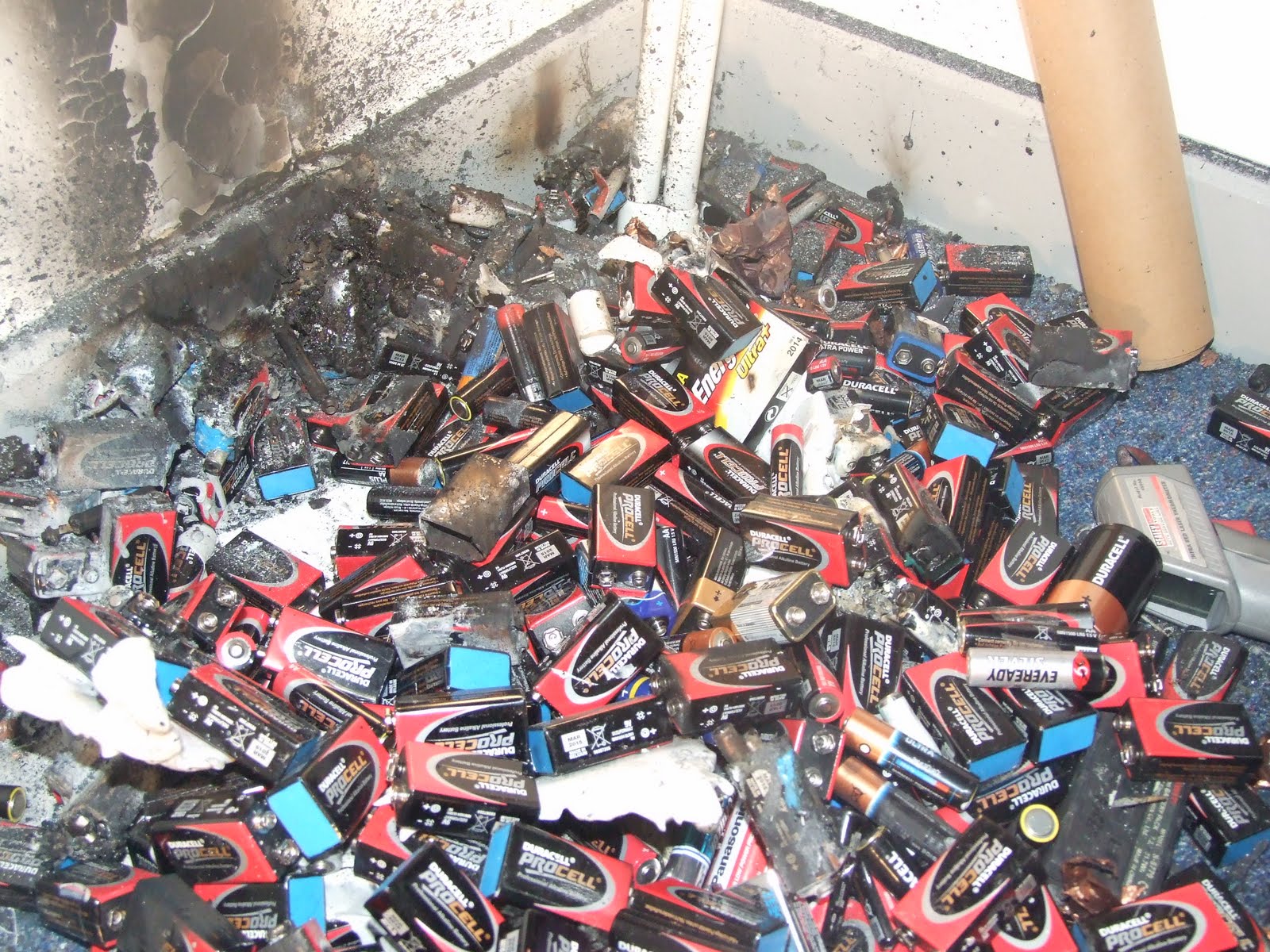
Every time I see Dave Townsend he nags me to put a blog up here. I’m due to meet him at IFE exam marking week soon so thought I had better do something quick!
Most of my most interesting investigations are still likely to end in court at some point so it’s probably best that I don’t discuss openly at this stage.
However, I recently investigated a fire that I had been ‘expecting’ for some time and am interested to know if anyone else has had a similar experience.
The fire started in a battery recycling collection bin, but thankfully didn’t spread every far. I have been expecting something like this since the WEE Regs (Waste Electrical Equipment) and Battery Directive came in. To be honest my concerns were more related to battery collection points in public buildings like shops and libraries.
The fire started in the wee small hours (see what I did there?) in a TV production company building that was unoccupied overnight. The alarm was raised by a smoke detector and the system worked well enough that a keyholder arrived shortly after the fire crews so they were able to get in and restrict the damage.
The plastic bin where the fire started was about the size of a bucket. It was used as a temporary collection point before transfer to a large wheelie bin in another part of the building. This wheelie bin contained thousands (no I didn’t count them!) of batteries.
The bin where the fire started contained hundreds of batteries (I gave up counting after 100) of various sizes, voltage ratings and technologies: Zinc/Carbon, Zinc Chloride, Alkaline, Lithium, Li-ion, AA, C, D and ‘exotic shapes’. (See photo at top) I found no coin batteries. However the predominant type was the 9 volt PP3 (MN1604) ‘smoke alarm’ battery with two terminals at one end. Clearly, if you chuck lots of these batteries in a bin sooner or later you will get a short circuit.
Apparently the camera crews used to empty their pockets at the end of a day’s filming. Although some were exhausted many of the batteries still delivered in excess of their rated voltage so were not exactly discharged! The boss was quite upset at the cost of recycling perfectly good batteries.
Also of interest was that one Li-ion camera pack battery was hot to the touch over 3 hours after the fire. One part of it measured 71.8 ºC.
Has anyone else come across anything similar?
Saturday, 19 March 2011
Dissertation Help
Good afternoon ladies and gentlemen.
Let me first introduce myself my name is Craig Poulter, I am a firefighter with Fire rescue New South Wales, and have been for 23 years. I am currently studying my masters in fire investigation and am looking for some help from my fellow investigators.
I am seeking information and documentation for my dissertation. At this stage it is to do with forensic and fire investigation evidence and their 'standing' in court, the number of convictions based on these experts and issues surrounding this.
Any information in regards to this subject would be most appreciated. I can be contacted on my e-mail which is;
craig.poult@internode.on.net
Thank you for your help
Craig A Poulter
L.L.B B.Bus JP GIFireE GradDipFireInvestign
Tuesday, 1 March 2011
Fires Caused by TV Aerials
Its a question more than a statement, for the time being at least, and strictly speaking I should call it "Incidents of Overheating". Anyway, I am currently investigating the circumstances surrounding two incidents at the same flat, within a council block of flats where the electrical lead has been subject to an overload. On both occasions the overload has passed only through the earth wire, within the lead. Faults within the domestic earth supply, the TVs and surge protection devices are all confidently eliminated, as are other non-electrical causes, such as arson, rodent infestation and external heat source. On no occasion have any of the protection devices in the appliance, plugs, leads or domestic circuit operated.
I have relied on assistance from external experts but the conclusion we are headed towards is an earth fault on a digital aerial that is split and boosted (at mains voltage) to more than 12 flats. There are a lot of interested parties in this case that has actually caused no real damage (thanks to an alert occupier and smoke detectors) but the potential for serious consequences is significant and depending on the agreed outcome (if that's possible!) could be far-reaching. I have sent a FINDS message out referring to this incident within the UK FRS community but if anybody else in the world of fire investigation has come across similar scenarios it would be interesting to hear of them.
Best regards, Alan
Wednesday, 26 January 2011
IAAI - UK
Having just returned from the IAAI-UK AGM and training event in London I would like to express here how much I admire and respect what has been achieved by all involved.
I had joined IAAI many years ago mainly for the forum site which at that time was very useful. Sadly, like many forums, bulletin boards etc. it fell into disuse and even some abuse.
The formation of the UK chapter took much time and devotion by those involved but it has clearly been worth it. The informal and open manner of the personnel and structure of the organisation is refreshing. Anyone and everyone is welcome. There are no cliques. It is not expensive. Through this body the professionalism and value of fire investigation will spread through Europe and the IAAI can be worthy of the title "International".
I would encourage anyone in the field to become involved with IAAI. It is now the most substantial independant organisation in this field.
I know some have issues with the heavy USA bias but to be fair that is where IAAI started and modern USA FI methods are now more closely similar to our own. Active involvement is the only way to influence or change any organisation and IAAI are open for change.
Most of us here on this IFE SIG panel are members and it was good to see half of us at the event. Looking forward to the next.
Wednesday, 29 December 2010
Discussion topic - Memorandum of understanding
MoUs between Police and Fire Service have been in existence for some years now but are they effective? There are still cases coming to court where a breakdown in communication between the two agencies has resulted in miss-trials and cases abandoned at the final hour. In one case to my knowledge a suspect's details were not passed on. That suspect committed a murder some months later. In another case samples had not been taken after a hydrocarbon canine had indicated and frequently the only report of investigation at court is a statement of likely cause or 'confirmation memo' from the Fire Service investigator. There is no investigation report or detailed statement from either agency.
All because the Police and Fire Service failed to communicate effectively.
MoUs outline very clearly the roles and responsibilities of all parties but who reads and fully understands the complexities of these documents and what may be missing from them? The communication breakdown occurs for many reasons: non-compatibility of shift systems, lack of experience, verbal messages not passed on, complacency and over-familiarisation.
Police Officers understandably perceive the fire service to be the experts and when told by a fire investigator that the cause of the fire was most likely deliberate the assumption is often made that the fire has been investigated. What they do not hear and are sometimes not told is that the fire has only been investigated up to that point.
Some Regional Fire Authorities have a closer working relationship but certainly not all. Some regions take a full role and effectively investigate crime scenes. This, I believe, is controversial and may be subject to challenge.
In any event I believe there needs to be a clear and written statement from the Fire Service investigator to the Detective in charge, for example:
"This fire has been assessed by the Fire Service to be most likely of deliberate origin. The Fire Service thus has no further jurisdiction. A full and comprehensive forensic investigation is now required to ascertain the actual cause of the fire and to obtain evidence with regard to any perpetrator. The Fire Service will assist if required. Please contact ..... "
Have other investigators had similar experiences? What are the solutions?
One thing is for certain. It must be resolved. Nationally.
Tuesday, 28 December 2010
Discussion topic - Investigation beyond level three
The CFOA steering group may touch on this subject and there still exists (just) a group discussing the subject in some detail but I would like to canvass our Group's views.
Let us call it 'Level 4' investigation for now. It clearly encompasses any event that effectively overwhelms the scope and capabilities of existing Level 3 investigations. Note that I did not say it overwhelms the abilities of investigators that work to level three. We all at some point are called upon to deal with incidents that are beyond our current experience but it is that very experience that is key to our effectiveness when stretched in this way.
But can 'Level 4' investigation ability be cost-effectively taught or pre-planned?
Is there a need? Is there the necessary finance?
In the past we have had to learn as we go. Many valuable lessons have been learned and applied at Atherstone for example but further lessons were learned there too.
I tend to feel that there is validity in having an established but necessarily broad procedure but training for such rare events would not be cost effective.
Seminars or travelling presentations of case studies is a good way to pass on lessons but how about a specialist team on standby call?
There is much to discuss and consider so shall we start? Share your views here. Let's get lively and straight-talking. Your pointers and opinions will be passed to the relevant discussion groups and I may precis them for the journal.
Tuesday, 26 October 2010
Aerosol can explosions
Currently working on a court report relating to the size and duration of a fireball resulting from an exploding aerosol can. The can was in a bin in a changing room so was probably 'empty' or nearly empty. There would still have been some residual flammable product in the can. Most of the literature relates to larger LPG releases and work with full aerosols.
I'm interested in colleague's thoughts, so please get in touch
I will share what I can after the trial.
Mike
Sunday, 17 October 2010
Chinese Lanterns
Dear All
I wonder if anybody has come across any fires where the supposed cause was the possibility of a Chinese lantern. This happened recently at a farm fire in my own service and was only identified as the possible cause due to an eagle-eyed witness.
More recently I was giving a Fire Safety talk to a group of farmers from the National Farmers Union and I was asked the question if the Fire Service supported calls from some insurance companies to have Chinese lanterns banned in the UK. I have to admit that I wasn't sure of the position of national bodies such as CFOA, but suggested that tighter controls and greater awareness of the risks were certainly required.
The difficulty, as I see it, for Fire Investigation Officers, is the possibility of a Chinese lantern is unlikely to feature highly on the list of possible causes and the release of such a lantern is most likely to be remote from where a fire started. I would be interested to know the likelihood of a Chinese lantern descending to the ground when it is still lit as my understanding is they would remain airborne until they have self-extinguished, however, that does not necessarily seem to be the case. Hopefully one for further discussion.
All the best
Alan
Sunday, 15 August 2010
Tealight candles
As many of you will be aware I have been taking a keen interest in tealights for many many years. Since my initial report in 1999 and subsequent studies I have endeavoured to monitor and drive the subject through publicity and shear doggedness. I believe I am at last in a position to be able to say that the work has been a success.
There are fewer incidents and deaths as a direct result of tealights burning abnormally and the recalls that have arisen are often as a result of the greater awareness of the tealight issue. There are also electric tealights now available!
The basic product, however, is the same and the DTI failed to initiate any effective safety strategy via retailers so how was the campaign a success?
CONTROLLED, DRIVEN AND TARGETED PUBLICITY:
- Fire services and trading standards accross the UK were well informed and included the issue in their own safety initiatives.
- The media were used to increase public awareness.
- TV makeover programmes and lifestyle magazines were mailed directly when tealights were portrayed dangerously.
- The advertising standards authority were informed and issued conditions for portrayal of tealights.
- Coroners were informed.
- Fire investigators were informed.
I am now in a position, I hope, to let the subject go. It will often be impossible to improve fire safety by design or regulation. When that is the case then shear dogged determination is the only option. I always carry the doctrine in my head "If I do nothing with the knowledge I have and somebody dies. What would any Coroner ask of me?".
IFE Forum and FI Blog
I have just had a quick look at the IFE forum and it is looking very sad indeed. Few entries at all this year and hardly any post seems to get any reply. Our own SIG has also been quiet. It's not a problem. We are all volunteers and have other matters to attend to but I would like to invite all to consider what pro-active measures we could take to reach a wider audience within IFE.
I would like to start with a monthly series of debate and advice on this blog site. The chosen subject will be posted onto the IFE forum and participants invited to this blog to enter the debate. Perhaps salient points can be summarised in our Newsletter. Please offer any subject or topic that you would like to see some discussion of and I will post it (please include a paragraph or information that will act as a springboard for the debate). If there is sufficient interest and activity I will publish the feature more widely.
My suggestions:
FI publications
Practical FI photography
Hand tools
On-site testing
Inter-agency working - Practicalities
Wednesday, 28 July 2010
Destroying the evidence...
The court case I sat through earlier this month is now reaching a conclusion. It has been extremely interesting as it involves a double killing and the victims’ bodies were destroyed in a very efficient manner in what is perhaps best described as a ‘homemade’ crematorium. The Bundeskriminalamt’s Forensic Experts have been involved by the defence team as the court had been advised that it was not possible to destroy a body, let alone two, in the manner described. However, the BKA team has shown that it is possible since the key element is not, as the original expert asserted, the temperatures generated or the method, but the combination of temperature and duration.
The court had a further difficulty in that the original investigation did not attempt to reconstruct the cremation equipment which the accused had, by that time, destroyed. Nor did they examine fully the information provided. Some ‘semantics’ were also involved which further clouded the issue, the accused stating that “the bodies were totally destroyed.” The use of the word “totally” was seized upon by the original expert as being “impossible”, but it is now accepted that this interpretation is far too narrow, since, to a layman, “totally destroyed” means being unable to recognise anything in the debris that he/she could identify as human.
So, how was this done?
The accused provided a detailed description of what he had done and how. When this methodology was examined fully and the implications studied and heat fluxes calculated it was found that the accused could well have destroyed the bodies sufficiently for the remains to be unrecognisable. His first step was to create a furnace.
To do this he cut the top off a small LPG ‘Bullet’ tank. This normally stands about 1.7 meters in height and has a diameter of 1.5 meters with a length of around 4 metres. Cutting the top off the tank reduced the height to 1.4 metres, allowing the fire bed to be fed from above. Slots approximately 100mm in length and 40mm in width were cut around the lower part of the tank, roughly 3-400 mm from the bottom. A fire was made inside the tank using wooden pallets and sustained until there was a deep bed of coals. More timber was then added to this and the first body, now wrapped in a poly-butylene “Butyl Rubber” pool lining sheet and placed inside a purpose made wooden ‘coffin’ was suspended over the top opening in the tank (This was 1 metre in width and the ‘coffin 900mm) and the fire using a mobile hoist. The Polypropylene strops melted and allowed the box to drop into the tank where the butyl sheet liquefied and promoted the rapid burning of the box.
Once the first box had begun to burn the second box was placed on top of it and caused the first to collapse, lowering the second completely into the tank.
Over the next eighteen hours the accused continued to stoke the fire, feeding in broken pallets from the top. This was one of the ‘issues’ the court had with the testimony since they believed the top would be too high for the accused to do this or to see into the tank unless he stood above the tank on an adjoining wall. However, this is where the original investigation was misleading. No one had drawn a scale drawing from the accused’s and other witnesses accounts. Once the BKA drawing was presented, complete with a to scale human figure, it immediately became obvious that not only was it possible to feed the fire as described, but to see into the tank without undue exposure to the heat or flames.
For me this underscored the need for investigators to make accurate scale drawings of anything they may need to look at in more detail or to verify witness descriptions. It certainly rocked the court’s perception and changed the opinion of the bench and assessors completely.
The calculations produced for the heat generated and output of a fire in these conditions were extremely complex, but showed that the burning pallet material would have produced sufficient heat to reduce a body and almost all the major bones to ash. When combined with the Butyl Rubber sheeting and the body’s own fatty tissues, the heat generated over the period of time given (18 hours) would have reduced the remains to fragments unrecognisable by any lay person. The BKA expert advised the court, and was supported in this by the Pathologist, that any larger pieces remaining would be sufficiently friable to be reduced to powder very simply either by handling or by the application of an acetylene torch on the premises. The accused’s reaction to this was sufficient to confirm suspicions that this is indeed what happened and he confirmed that verbally to the open court!
The calculations for radiant heat from the tank also confirmed that anyone ‘feeding the fire’ would be able to do so with only slight heat discomfort at a distance no more than 500 mm from the tank wall.
One of the many things that has caused a problem with this case is the fact that, though the accused showed the police where he had scattered the remains in a field, no attempt was made at the time to collect any samples from it or from the area where the tank had stood. Had this been done, the BKS team could have analysed it using X-Ray diffraction, a technique that reveals the crystalline structures off a variety of chemicals and would have shown up the Calcium Phosphates unique to human bones…
Sitting in on this case has been a fascinating learning experience, not least for the scientific analysis of the process, but for the identification of the many deficiencies in the original investigation. The court is to sit again on the 1st of August to hear a statement by a co-accused and the judgement will follow, I suspect, within days of that. It certainly bears out, for me, the vital necessity for fire investigators to understand the recording, recreation and evidence examination techniques as well as the fire!
Hopefully, at some point I will be able to post the drawings and some of the calculations on this site – but for the moment this is verboten!
Friday, 2 July 2010
Court procedure; German style
I thought readers might be interested in a brief review of the court case I attended last week. I hasten to add, as a spectator, not in any "official" capacity.
The case is an interesting one for a number of reasons. The accused is charged with two counts of manslaughter and disposed of the bodies by burning them in a very interesting manner. This is the reason I attended the trial and I will give more details when I am able to do so.
The German Courts have no Jury, the bench has five members, with a Presiding Judge, two Assessors and two lay members drawn from the electoral rolls by ballot in much the same manner as the UK's Jury Selection process. One difference, however, is the fact that potential lay members are screened to ensure they are qualified to understand the complexities of the case. Seated on either side of the court, with the defence at a level lower than the bench, are the Prosecutor on the Right of the Bench and the Defence facing him on the left. A major difference with a UK Court is the presence on the Prosecution's side of a Legal Rep and the victim's family representative, with another Legal Rep on the Defence side representing the accused's family! Cross-examination is generally led, as in the UK system, by the Prosecution, followed by the Defence, but then the other two parties are also allowed to examine the witness as are the three judges.
On the day I was present the evidence was being given by a Pathologist and a representative of the Bundeskriminalamt's Forensic Science Institute's Fire Investigation Unit and the questions all revolved around the method of destroying a body by fire. Watching the cross examination and listening to the technical answers proved very interesting indeed. Video of some experiments was shown, powerpoint was used, copies of technical papers circulated and examined and the court even adjourned to read a rather longer and more complicated one submitted by the FIO.
In the end the court adjourned, but issued a recall for the experts for later this month to answer specific questions raised in the evidence and which will require further research and calculation.
One thing was clearly evident throughout, bias is very difficult to sustain in this environment since, with four legal teams present and the bench any attempt at bias is quickly revealed. Unlike the "Adversarial" approach in the UK which does teend to sway a jury, there is a much calmer and more inquisitorial approach in this system. That said, don't try to evade a question or deliver a half answer. The Judges are very quick to demand a proper response and to dismiss anything which is inappropriate.
So how do the "Lay" members of the bench function?
They are also permitted to ask for explanations, though they usually do so through one of the Judges. Their main function is to listen, to watch and to assist the Judge in reaching a conclusion - and obviously, to ensure that conclusion has been reached in a balanced and even handed manner.
Of all the courts I have attended, this one struck me as being very fair in its deliberations (Interestingly the BKA witness and the Pathologist were called by the Defence Team.) and to contain some checks and balances not always present in a jury system. Giving evidence in this style of court may be slightly more 'relaxed' but is still no place for ill-informed or unscientific witnesses, the least suspicion of unqualified or unquantifiable answers or of unsubstantiated evidence is likely to bring down the wrath of the bench on the witness and get the evidence challenged and dismissed.
If you're lucky, you'll escape with a caution not to waste the courts time...
Having watched this court at work, I seriously recommend to everyone that time spent in the public gallery of a range of different courts and legal systems will be time very well spent indeed.
Sunday, 20 June 2010
Investigation of major fires
Please see link in new page opposite. Any suggestions or contributions to this new group will be very welcome and will be passed on.
The background is that major fire investigation is well removed from level 2 and 3 and that we appear to be learning on our feet as and when major incidents occur. The group will seek to find common ground or procedure that any Police or Fire Authority can use as a template.
The background is that major fire investigation is well removed from level 2 and 3 and that we appear to be learning on our feet as and when major incidents occur. The group will seek to find common ground or procedure that any Police or Fire Authority can use as a template.
Saturday, 22 May 2010
FI workshop 20th May - feedback
Link: www.cfoa.org.uk/download/16477
I found this workshop very interesting. It will clearly generate much of the schedule of the forthcomming FI Stategy Group:
- The South East Regional FI set up appears to me to be a very good role model. It is an excellent example of what can be achieved by determined effort from experienced practitioners and supportive, modern management. David Wales will fill you all in with more detail in the newsletter perhaps.
- Hampshire FRS presented an excellent Police/Fire Service investigation scheme that turns much current working practise and training on its head. Hampshire FRS investigators now fully work fire-related crime scenes! There may be some legal issues and there must surely be some training issues.
- Durham and Darlington FRS offer a FI degree that appears sufficiently comprehensive and good value for money. At present it is only available to FRS investigators.
Our profession is marching on rapidly but it is fragmented. I hope that the FI Strategy Group can achieve greater National cohesion, standards and comunication.
Subscribe to:
Posts (Atom)